Every algorithm is a string of symbols, and every symbol is one turn. Hold the
cube white on bottom, yellow on top — the grip for the whole course — and
note that letters name positions, not colours: F is whichever face points
at you right now.
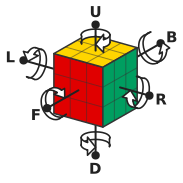
L, D and B look the other way round from your seat.The six faces
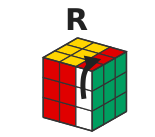
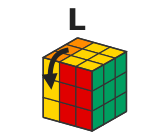
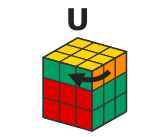
A bare letter means one quarter turn (90°) of that face, clockwise as if you were looking at it head-on.
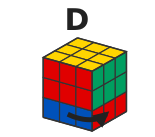
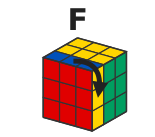
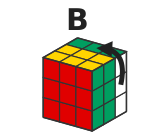
Prime, double, wide
Three marks modify any letter:
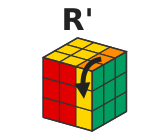
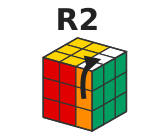
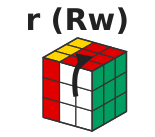
- ’ (prime) — counter-clockwise instead.
R'exactly undoesR. - 2 — a half turn (180°). Direction doesn’t matter; both ways land the same.
- lowercase — wide: turn two layers, the face plus the slice behind it.
Slices
The three middle layers have their own letters:
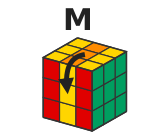
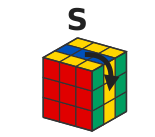
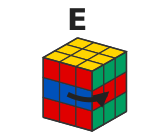
M— betweenLandR, turns the same direction asL.S— betweenFandB, followsF.E— betweenUandD, followsD.
Slices move centers, so mid-algorithm the whole cube looks recoloured — that’s
normal. Only M appears in this course, in the Phase 3 edge algorithms.
Rotations
x, y, z turn the whole cube in your hands. No piece moves relative to
any other — a rotation is just “regrip”, which is why algorithms sometimes
start with one.
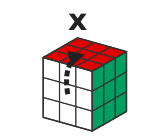
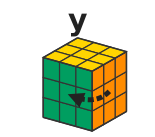
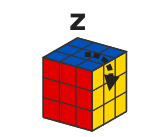
x— likeR: the front face tips up.x2flips the cube upside down — Phase 1’s “flip”.y— likeU: the right face swings round to the front.z— likeF. You’ll rarely need it.
Your first trigger
Read R U R' U': four symbols, four turns — R, U, R',
U'. This is the sexy move, and it’s the spine of nearly every algorithm
you’ll learn here.
Drill: from a solved cube, repeat R U R' U' six times. The cube returns to solved — any fixed sequence eventually cycles back, and the sexy move’s cycle is exactly six. If it doesn’t come back, one of your 24 turns was wrong: slow down and re-read. Repeat until your hands run it without your eyes.
That drill is also why notation matters less than it looks. You won’t read
algorithms letter by letter for long: F R U R' U' F' is
written as six symbols but read as three chunks — F, sexy move, F'. Nearly
every algorithm in this course decomposes into triggers like that.