A 3×3 cube looks like 54 stickers that move anywhere. It isn’t. It’s 26 solid pieces, and each kind can only ever trade places with its own kind.
The three kinds of pieces
- 6 centers — one per face, a single color. Centers never move relative to each other: the white center is always opposite yellow, red always opposite orange, blue always opposite green. The center is the face’s color.
- 12 edges — two stickers each. An edge lives between two centers and can only swap with other edges.
- 8 corners — three stickers each. Corners only swap with corners.
What a layer is
A layer is one of the three slabs of nine pieces on an axis. Every turn moves exactly one layer. Top, middle and bottom are the three layers you will hear named most: the course fills the bottom layer first, then the middle, and spends its last four steps on the top.
How to hold it
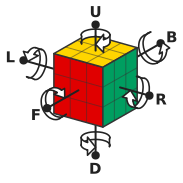
Hold the cube with white on the bottom and yellow on top — every lesson on this site assumes that grip. With red facing you, green is on your right and blue on your left. The opposites fill themselves in: white under yellow, orange behind red, blue opposite green.
What “solved” actually means
Each piece sits between the centers that match its stickers. That reframing does real work: when a lesson says “put the white-red edge home,” you now know exactly where home is — between the white center and the red center — without memorizing anything.
If your cube seems impossible
A corner rotated in place, or an edge flipped in place, by popping and reassembling (or by a previous owner) makes the cube unsolvable — no sequence of turns fixes it. If a guide “stops working” at the last layer with one twisted corner, pop that corner out gently and turn it back, or twist it in place. That’s repair, not cheating.