Freeslicing works because a broken edge group elsewhere absorbs the damage from your slice moves. With ten groups done, nothing is left to absorb it — the last two groups have no spare slot to work in.
You do not need a case set for this. You need the flip you already have, aimed by hand.
Slice, flip, slice back
Take one slice out so the two unfinished groups sit across from each other, flip the front-right group with the algorithm from the last lesson, and put the slice back:
R U R' F R' F' RRepeat it. Each round trades a wing into place, and you keep going until the two groups are whole — usually two or three rounds, sometimes more if you aim badly. It is slower than a one-look case set, which is exactly the trade: no recognition table to learn, and a 5×5 you can actually finish today.
There is one thing this loop cannot fix, and you meet it in half your solves.
Edge parity
Half of your solves end with this: the last group sits in its slot looking flipped, everything else paired. On a 3×3 that state is impossible — flipping a single edge breaks the permanent laws of the puzzle. Here it is expected, and one dedicated algorithm fixes it.
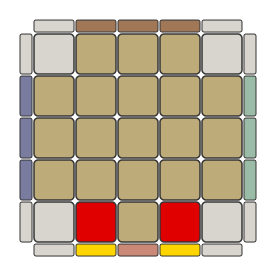 Rw U2 x Rw U2 Rw U2 3Rw' U2 Lw U2 Rw' U2 Rw U2 Rw' U2 Rw'
SolvingEdge Parity (5×5)
Starts at the case. Full colour is what this step solves, dim is already solved and has to survive it, grey is further down the method.
Open the full case page →Hold the flipped group at UF — top layer, facing you. That is not a stylistic note: the algorithm was tested against the same state held at UB, UR, FR and DF, and it only solves it at UF.
Two things it does on the way, both measured, and both harmless: it swaps the UR and UL edge groups, and it swaps two corners. Those are legal 3×3 states your own method finishes. Nothing is broken — do not undo it and start again.
Why parity exists at all
Everything you do while pairing swaps wings in pairs. Turn an outer face, flip a group, conjugate the flip by any slice you like — every one of those moves an even number of wings, and no combination of them can ever add up to an odd number.
Parity is the state where one swap is left over. That is why no amount of pairing technique reaches it, and why it needs an algorithm of its own rather than more of what you were already doing.
Why there is no PLL parity
A 5×5 has a true fixed center piece on every face, so the color scheme is anchored absolutely and its midges obey 3×3 permutation law. Every last layer you meet is a genuine 3×3 last layer, solvable by the algorithms you already own — the flipped-looking edge above is the only surprise a 5×5 can throw, and it lives here while you pair the edges rather than at the end of your solve.
You’re done learning
A 3×3 solver who has worked through these lessons holds everything a 5×5 can ask, and it is a short list: two algorithms and one technique. The flip, the parity fix, and the centre insert you aim rather than recall. Build centres, pair edges, fix the parity when it appears, and let your 3×3 finish the solve.