Today the last-layer order changes, permanently: orient edges → orient corners → permute corners → permute edges. All orientation first, then all permutation. This is the CFOP order, and nothing you learn later will rearrange it again.
Why it wins: in the beginner order the yellow face came together last, so every step meant re-scanning a half-scrambled top. Orientation-first means that once the corners are done, the top is solid yellow — every remaining decision reads off side stickers alone. The finished method is still only nineteen algorithms in daily use; the switch itself costs two and retires three — Niklas and both Orient Corners finishers have no job once corners are oriented first.
Grip stays the same throughout: white on the bottom, yellow on top. Nothing changes before the last layer — solve the cross, the first two layers, and the yellow cross exactly as before. The switch starts here.
1. Orient corners: chain Sune
Yellow cross done. Look at the four top corners: some show yellow on top, the rest have their yellow sticker twisted onto a side. You already own the tool that fixes this.
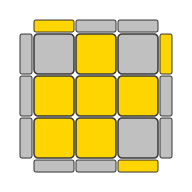 R U R' U R U2 R'
SolvingSune
Starts at the case. Full colour is what this step solves, dim is already solved and has to survive it, grey is further down the method.
Open the full case page →If you see exactly the Sune case — one yellow corner in the front-left, the other three twisted clockwise — one Sune finishes the top. For any other corner pattern, apply Sune from any angle, then look again. Repeat until the top is solid yellow or the Sune case appears. It always converges within a few passes, because Sune twists three corners at once while leaving the fourth alone.
2. Permute corners: T-Perm
The top is all yellow, but the corners may sit in each other’s slots. Read the side stickers: on each side face, check the two corner stickers. Two matching corner stickers on one face are headlights — a car seen head-on. The edge between them doesn’t have to match.
Hold the headlights on the left, then run T-Perm — it swaps the two right-hand corners and leaves the yellow face untouched.
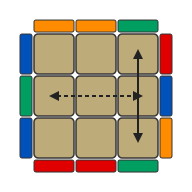 R U R' U' R' F R2 U' R' U' R U R' F'
SolvingT-Perm
Starts at the case. Full colour is what this step solves, dim is already solved and has to survive it, grey is further down the method.
Open the full case page →- Headlights on one face — hold them left, T-Perm once.
- No headlights anywhere — that’s a diagonal swap. T-Perm from any angle creates headlights; hold them left, T-Perm again.
- Headlights on every face — corners are already permuted. Skip ahead.
Y-Perm, the dedicated diagonal solver, arrives in Phase 3.
3. Permute edges: Ub
Turn U until every corner matches its side center. All that remains is three or four top edges out of place. Find the solved edge — the one whose side sticker matches the face it sits on — and hold it at the back.
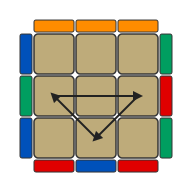 R2 U R U R' U' R' U' R' U R'
SolvingUb
Starts at the case. Full colour is what this step solves, dim is already solved and has to survive it, grey is further down the method.
Open the full case page →- No solved edge? Apply Ub once from any angle — one appears. Find it, hold it at the back, apply again.
- Front edge wants to go right, not left? That’s Ua, whose M-slice algorithm arrives in Phase 3. Until then, Ub from the same grip still works — it converts the case into its mirror; one more Ub finishes.
Repeat the routine — find the solved edge, back, Ub — until the cube is solved. You will never need more than three passes.
That’s the switch complete. Same solve, two new algorithms — Phase 3 only fills in the remaining cases so each look becomes a single algorithm.